
Solar vs Nuclear: Firm Power for the AI Grid
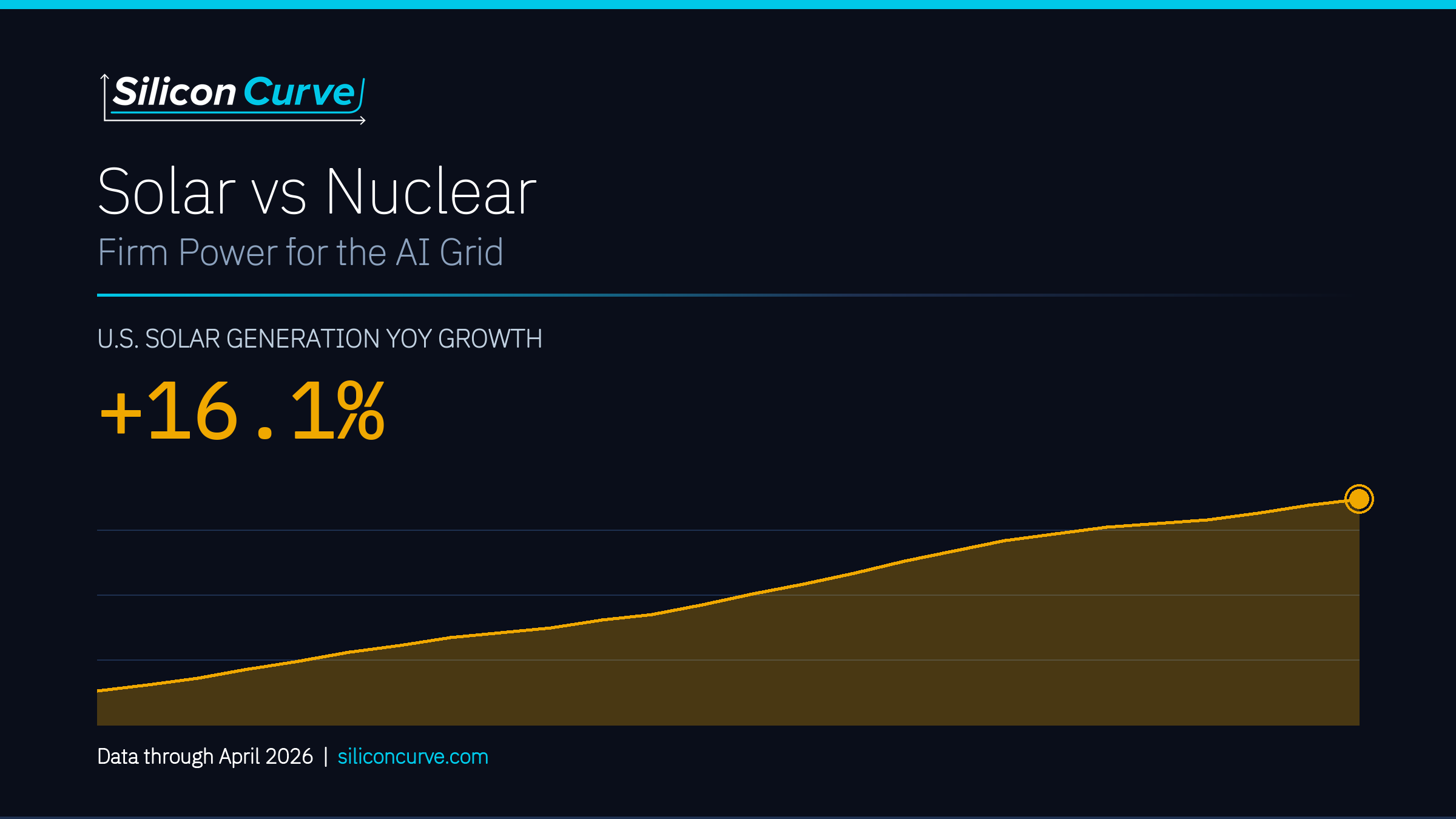
Solar vs nuclear as power for AI data centers: U.S. solar generation grew 16.1% year-over-year to a 313.1 TWh annual run-rate, while nuclear held near-flat at 786.0 TWh, a volume story meeting a firmness question.
This report frames solar vs nuclear as two ends of the firmness spectrum for powering AI data centers, which require firm, around-the-clock electricity. The federal data available here measures generation volumes and retail electricity prices, it contains no generation-cost or levelized-cost data. This is therefore a comparison of generation profiles and volumes, not a cost verdict. Over the 12 months through April 2026, U.S. nuclear generation totaled 786.0 TWh and U.S. solar generation totaled 313.1 TWh. Nuclear provides near-constant baseload output; solar output is strongly seasonal and diurnal. The central question for data center siting is not which source produces more today, but which can deliver firm capacity, a profile question the volume data illuminates but does not settle.
Near-constant baseload
Strongly seasonal
Volume expansion
Seasonal April trough
U.S. solar generation is growing rapidly, up 16.1% year-over-year, while nuclear generation held essentially flat at a much larger annual volume of 786.0 TWh versus solar's 313.1 TWh. But volume growth is not firm capacity. Solar's output collapses seasonally: its 36-month monthly low of 9.1 TWh (December 2023) is roughly a quarter of its 33.4 TWh July 2025 peak. Nuclear's monthly output stays within a far narrower band. For AI data centers that need power 24/7, the data shows solar closing the volume gap but not the profile gap. This is a generation-profile comparison, not a cost conclusion, the dataset contains no levelized-cost figures.
- MAGNITUDE, U.S. nuclear generation reached 786.0 TWh over the 12 months through April 2026, versus 313.1 TWh for solar over the same period. Nuclear remains the larger firm-power source by volume.
- DIRECTIONAL CHANGE, U.S. solar generation increased 16.1% year-over-year in April 2026 (+4.3 TWh for the month), reflecting sustained volume expansion; nuclear was -0.9% over the same comparison, a seasonal refueling trough rather than a capacity decline.
- STRUCTURAL SIGNAL, Economy-wide IT equipment and software investment reached $1,556.5B in Q1 2026, up 18.7% year-over-year, sustained expansion consistent with continued data center buildout, though this is an economy-wide measure, not a data-center-specific figure.
U.S. nuclear generation dips every spring and fall for scheduled refueling outages. April is consistently the annual low in this dataset. The -0.9% April-over-April figure is therefore a seasonal comparison, not evidence of capacity decline or a ceiling. Nuclear's 36-month monthly peak of 73.3 TWh occurred in January 2026, a winter-demand high, while its trough of 57.4 TWh landed in April 2026.
Solar shows the opposite and more extreme seasonality: high summer output, low winter output. This diurnal-and-seasonal variability is the core economic tradeoff against nuclear's near-constant baseload when siting facilities that require firm, around-the-clock power.
Solar's intra-period swing is substantial: the July 2025 monthly peak of 33.4 TWh versus the December 2023 trough of 9.1 TWh reflects a peak-to-trough range exceeding 250% within the 36-month window. Nuclear's monthly output remained within a much tighter band (a 57.4 TWh April 2026 low to a 73.3 TWh January 2026 high). This variability gap, not total volume, is the defining distinction for firm-power siting.
TABLE OF CONTENTS
- Executive SummaryFree
- Grid Baseline: National Scale and Capacity Context🔒
- Nuclear: The Firm Baseload Reference🔒
- Solar: The Volume Growth Story🔒
- Operating Cost Context: Industrial Electricity Prices🔒
- State Lens: Virginia and Texas Load🔒
- Capital Signal: IT Investment Behind the Buildout🔒
- Synthesis: Profile, Not Cost🔒
- Data Appendix🔒
- Endnotes🔒
- U.S. Energy Information Administration
- Federal Reserve Bank of St. Louis / BEA
The full report compares U.S. nuclear and solar generation profiles for AI data center power, with national grid baseline, industrial price context, Virginia and Texas state load, and the IT investment capital signal behind the buildout.
Read the Full Report ($49 value)
Every chart, table and appendix, unlocked instantly and yours for the life of the report.
No credit card or account required.
We'll also send you our newsletter. Unsubscribe at any time.
Or Buy It Outright
Buy This Report, $49One report, yours permanently. The free copy is one per reader.